

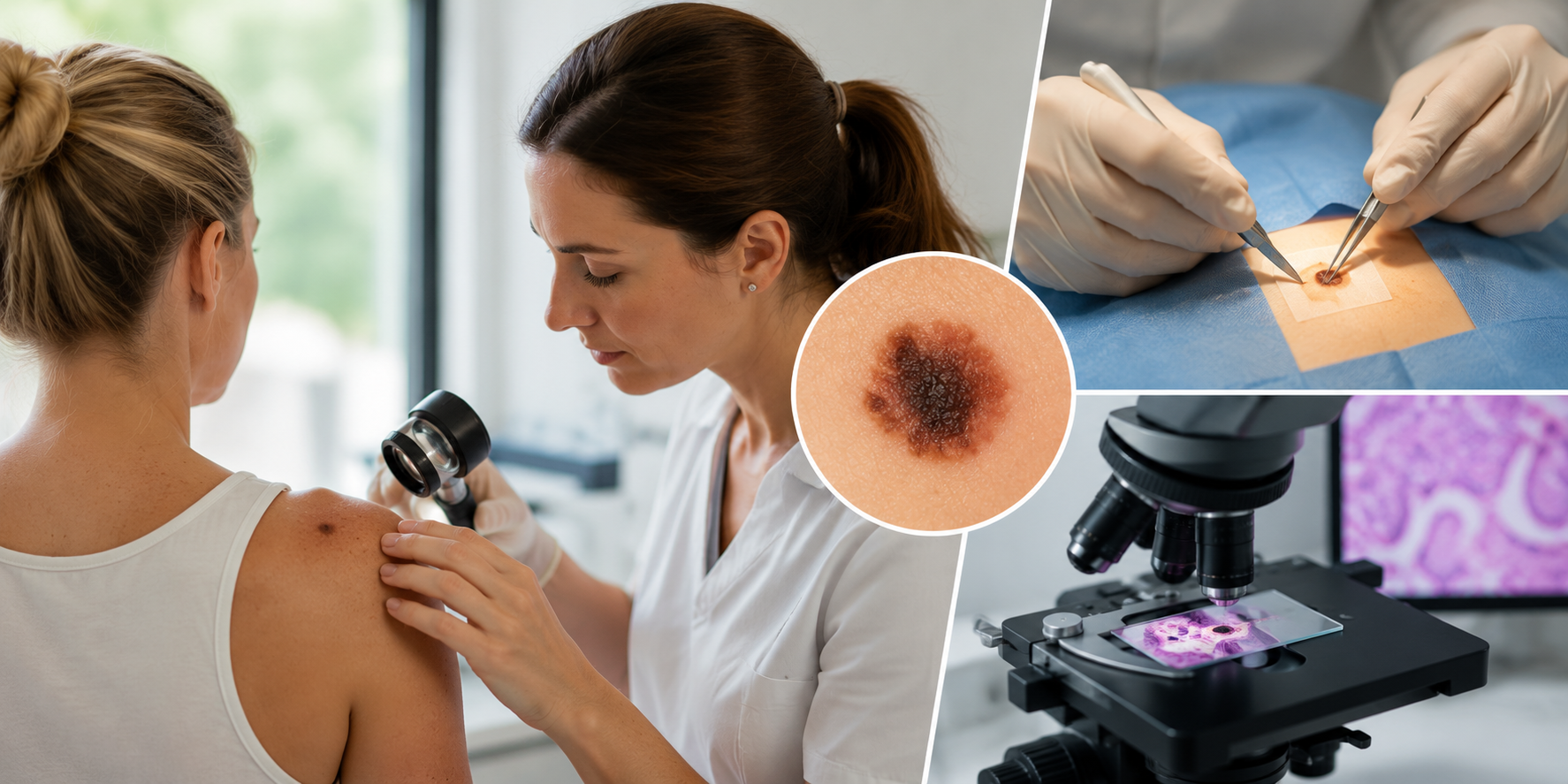
Few sentences raise the pulse like a doctor saying, “I would like to take a closer look at that spot.” If you have ever left a skin check with a biopsy booked or a lesion flagged for removal, you will know the uneasy wait that follows. The uncertainty is often harder than the reality. Understanding what actually happens after a suspicious spot is found can take a great deal of the fear out of the process.
Living on the Gold Coast means living with high ultraviolet exposure, and Australia has one of the highest rates of skin cancer in the world. The reassuring truth is that most skin cancers are highly treatable when caught early, and the pathway from a flagged spot to a resolved one is usually more straightforward than people expect. Here is how skin cancer management works.
It Starts With the Skin Check
Every skin cancer pathway begins with a thorough examination. During a full body skin assessment at Haan Health, our experienced doctors methodically examine your skin from head to toe, including areas you cannot easily see yourself. If a spot looks suspicious, the doctor does not guess. They investigate, and that is the point at which management begins.
For guidance on sun protection and reducing your ongoing risk, Cancer Council Australia is an excellent independent resource to read alongside regular checks.
Step One: Biopsy and Histopathology
When a lesion needs closer examination, the next step is usually a biopsy. This involves taking a small sample of the spot, or sometimes removing it entirely, and sending it to a laboratory for histopathology. Under the microscope, a pathologist can confirm exactly what the spot is, whether it is harmless, pre-cancerous, or a skin cancer, and if so, what type. This is the step that replaces uncertainty with a clear answer, which is why it matters so much.
The biopsy itself is a minor procedure performed with local anaesthetic, so you remain comfortable throughout. Your doctor will explain what to expect and how you will receive your results.
Step Two: Treatment and In-House Removal
If a skin cancer is confirmed, the good news is that many can be treated in the clinic. Haan Health offers in-house minor surgical removals, which means a large proportion of skin cancers can be dealt with on site, sparing you a separate trip elsewhere and reducing the waiting involved. The approach depends on the type, size, and location of the cancer, and your doctor will talk you through the plan clearly before anything happens.
Because our Broadbeach clinic has onsite pathology and diagnostic services, the whole process, from biopsy to results to treatment, can be coordinated smoothly in one place. For anyone anxious about a spot, that continuity means faster answers and less running around.
Step Three: When a Specialist Referral Is Needed
Some skin cancers require more specialised treatment, whether because of their type, their size, or their position on the body. In these cases, your GP will arrange a prompt referral to the appropriate specialist, such as a dermatologist or a plastic surgeon, and remain involved in coordinating your ongoing care. You are never simply handed off and forgotten.
Understanding the Main Types of Skin Cancer
It helps to understand, in general terms, the three most common types your doctor may discuss:
- Basal cell carcinoma (BCC). The most common and least aggressive type. It tends to grow slowly and rarely spreads, and is very treatable, especially when found early.
- Squamous cell carcinoma (SCC). More likely than BCC to grow and, if left untreated, to spread, which is why timely treatment is important.
- Melanoma. Less common but more serious, because it can spread if not caught early. This is exactly why early detection and prompt management are so valuable.
The common thread across all three is that early detection changes the outcome. A spot dealt with promptly is usually a minor event. The same spot left for a year can become a far bigger one.
After Treatment: Ongoing Monitoring
Being treated for one skin cancer does not mean the story is over. People who have had a skin cancer are at higher risk of developing another, so ongoing monitoring becomes an important part of your care. Your GP will usually recommend more frequent skin checks going forward, and will keep an eye on the treated area to make sure it has healed well. This is where having a regular practice pays off, because your doctor knows your history and can compare your skin over time rather than starting fresh at every visit.
Between checks, getting to know your own skin remains one of your best defences. If you notice a new spot, or an existing one that changes in size, shape, or colour, or that itches, bleeds, or will not heal, book an appointment rather than waiting for your next scheduled check.
Reducing Your Risk on the Gold Coast
Management is not only about treating what is found. It is also about lowering the chance of new skin cancers forming. On the Gold Coast, where sun exposure is part of daily life, simple sun-safe habits genuinely add up over the years. Seeking shade during the middle of the day, wearing a hat and protective clothing, applying and reapplying sunscreen, and being mindful during outdoor work and recreation all reduce your cumulative ultraviolet exposure. These habits, combined with regular professional checks, are the most effective way to protect your skin long term.
Do Not Sit on a Spot You Are Worried About
If you have a spot that has changed, a mole that looks different from your others, or something that itches, bleeds, or will not heal, do not wait and hope. For residents across Broadbeach, Mermaid Waters, Surfers Paradise, and the wider Gold Coast, getting it assessed quickly is the single best thing you can do.
Book a skin check or discuss a spot of concern at Haan Health Medical Centre in Broadbeach by calling (07) 5531 6033 or booking online. Early answers bring peace of mind.